
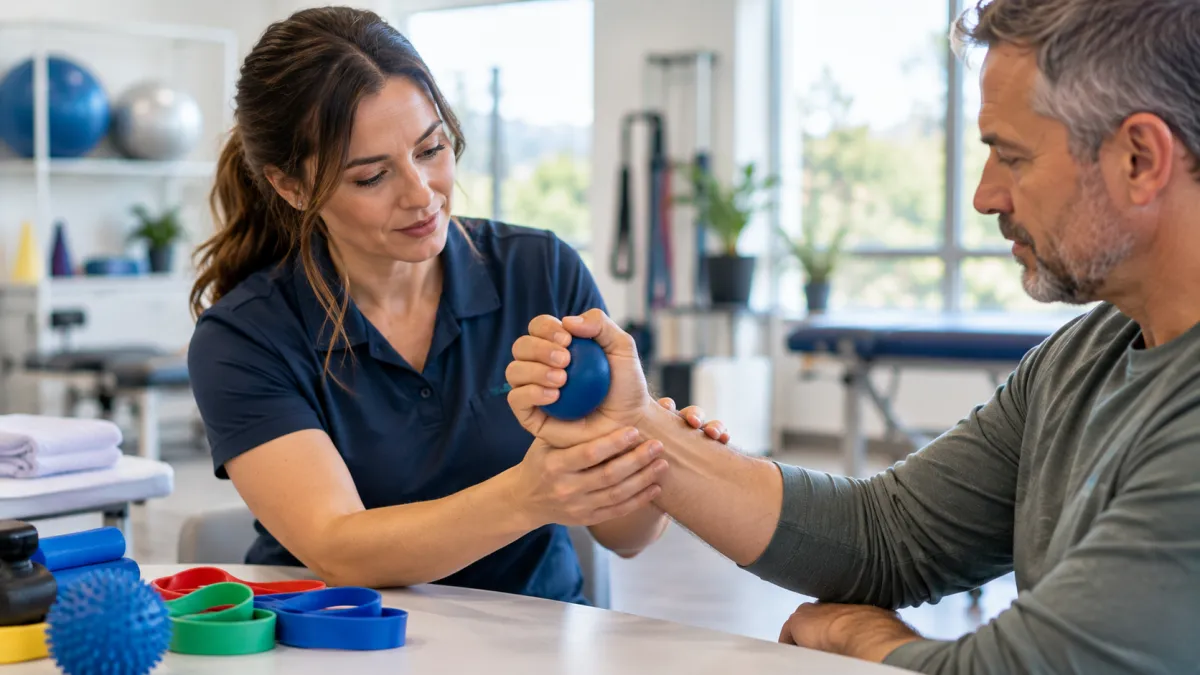
What Hand Therapy Treats and What to Expect When You Start
Your hands are involved in almost everything you do. Gripping a mug in the morning, typing through the workday, holding a child's hand, turning a key in a lock. When pain, stiffness, or weakness affects that function, it is not just inconvenient. It can make ordinary life feel unfamiliar.
Hand therapy is a specialized form of rehabilitation focused on exactly this problem: restoring the strength, mobility, and coordination your hands need to do the things that matter to you. If you have been told you might benefit from hand therapy and are not sure what that means, this is a straightforward explanation of who it helps, what happens during treatment, and what recovery can look like.
What Conditions Does Hand Therapy Address?
Hand therapy is designed for a wide range of conditions affecting the hands, wrists, forearms, elbows, and shoulders. Some of the most common include the following.
Fractures and dislocations are among the most frequent reasons people come to hand therapy at Convivio Health. Bones in the hand and wrist heal, but the process can leave behind stiffness, reduced grip strength, and difficulty with fine motor tasks. Therapy after a fracture helps restore movement and function so the healed bone is actually usable again.
Carpal tunnel syndrome affects the median nerve as it passes through the wrist, causing numbness, tingling, and weakness in the thumb and first few fingers. Hand therapy can relieve symptoms through nerve gliding exercises, activity modification, and splinting. For patients who have had carpal tunnel surgery, therapy afterward helps restore full function.
Tendon injuries require careful, staged rehabilitation. The tendons that flex and extend your fingers are precise structures, and injuries to them, whether from lacerations, ruptures, or overuse, need protection through each phase of healing while still working to restore full range of motion and strength.
Trigger finger occurs when a finger catches or locks as you try to straighten it, usually due to inflammation of the tendon sheath. Hand therapy uses splinting and targeted exercises to reduce irritation and restore smooth movement.
Nerve injuries and nerve compression, including conditions affecting the ulnar, radial, or median nerves, can cause weakness, loss of sensation, or difficulty with coordination. Rehabilitation focuses on protecting the nerve during healing, regaining strength in the affected muscles, and rebuilding the sensory feedback that makes precise hand movement possible.
Arthritis, both osteoarthritis and rheumatoid, can significantly reduce hand function over time. Hand therapy does not reverse the underlying disease, but it can reduce pain, preserve joint health, improve grip strength, and teach strategies for protecting your joints during daily activities.
Post-surgical recovery is one of the most common reasons people are referred to hand therapy. Surgery on the hand, wrist, or elbow often requires structured rehabilitation afterward to achieve the full benefit of the procedure. Whether the surgery involved fracture fixation, tendon repair, carpal tunnel release, or joint replacement, therapy helps guide the tissue back to functional capacity in the right sequence.
What Happens During a Hand Therapy Session?
The first appointment is an evaluation. A hand therapist assesses your strength, range of motion, coordination, sensation, and what specific tasks are difficult for you. This becomes the foundation for a treatment plan designed around your condition, your goals, and how you actually use your hands day to day.
Treatment sessions typically include a combination of manual therapy techniques, targeted exercises, and modalities such as electrical stimulation or ultrasound when appropriate. If a custom splint would support your recovery, it can be fabricated and fit during your sessions. Splinting is a core part of hand therapy, used both to protect healing tissue and to gently improve range of motion over time.
The progression of therapy follows the healing process. Early sessions often focus on reducing pain and swelling and protecting healing tissue. As recovery advances, the focus shifts to restoring strength and coordination, and then to the functional activities that matter most to you, whether that means returning to a physically demanding job or being able to button a shirt again.
What a Certified Hand Therapist Brings to Your Care
Hand therapists are occupational therapists or physical therapists who have completed advanced training specifically in upper extremity conditions. A Certified Hand Therapist, or CHT, has met additional requirements in clinical practice and passed a certification examination in this specialty area.
That depth of training means a hand therapist approaches your hand not just as a collection of muscles and tendons, but as a finely coordinated system. The small bones, complex joint mechanics, intricate nerve pathways, and precise tendon movements of the hand require a specialist who understands how these structures interact and how to support them through each stage of healing.
How Long Does Hand Therapy Take?
Recovery timelines depend on the condition, the severity, whether surgery was involved, and how the tissue responds over time. Some patients complete a course of therapy in a few weeks. More complex injuries or post-surgical cases may take several months.
What matters more than the timeline is the trajectory. Consistent progress through the phases of healing, even if that progress is gradual, is what distinguishes a recovery that reaches its full potential from one that plateaus early. A good hand therapy program is specific enough to keep that progression moving in the right direction.
What to Expect From Hand Therapy at Convivio Health
At Convivio Health, hand therapy is part of a broader rehabilitation environment that includes occupational therapy, physical therapy, and other clinical specialties. That context matters when your hand condition is connected to a more complex injury or when you benefit from access to additional services alongside your hand therapy.
Your therapist will work with you to set goals that are meaningful to you, track your progress with objective measures, and adjust your plan as your recovery develops. The aim is not just to reduce your pain score on paper but to restore the function that lets you do the things you care about.
If you are dealing with a hand, wrist, or upper extremity condition and want to learn whether hand therapy is the right next step, visit the Convivio Health hand therapy page or contact the team to get started.