When Work Is Part of Who You Are: The Physical and Emotional Reality of a Work Injury
Imagine telling everyone you're doing fine, except you haven't slept well in three weeks, you're avoiding phone calls, and you're not sure if you'll ever do your job the same way again.
That's what a work injury actually feels like for a lot of people. Not dramatic. Not visible. Just quietly overwhelming.
Most people expect physical recovery to be the hard part. The pain, the appointments, the exercises. What they don't expect is how much the injury affects their sense of who they are and how that emotional weight, if left unaddressed, can slow the whole recovery down.
At Convivio Health, we see this reality every day. And according to Anne Hardy, DNP, FNP, a Nurse Practitioner who works with injured workers across Washington State, the emotional disruption is often the piece that catches people most off guard.
"I identify myself probably first as a nurse practitioner or a nurse," she shared in a recent conversation on Work Injury WA. "If somebody took that away from me, I would feel very lost."
That's what a work injury does. It doesn't just limit what you can do, it can temporarily remove the role that gives your life structure, purpose, and a sense of self.
Why Work Injuries Affect More Than the Body
Work provides far more than a paycheck. For most people, it brings routine, community, financial stability, and a sense of contribution. When an injury suddenly removes all of that at once, the effects ripple outward in ways that are hard to predict.
Sleep is often the first thing to go. Pain makes it hard to find a comfortable position. Stress about bills, about returning to work, about your family, keeps the brain in a state of alert long after the lights go out. Sleep disruption then creates its own cascade: poor concentration, increased irritability, lower pain tolerance, and emotional flatness that can feel like depression.
Isolation compounds quickly. Not being at work means losing daily social contact. For workers whose jobs form the core of their social world, an injury can feel like a sudden and total loss of community, particularly for those who spend most of their waking hours with coworkers.
Financial pressure adds another layer. Worrying about making ends meet activates the same stress systems that physical pain does, making both harder to manage. For sole providers, that pressure can feel crushing.
None of this is weakness. These are predictable responses to a genuinely difficult situation.
The Nervous System Remembers
One of the most important things to understand about recovery, and one that often goes unsaid, is that the body can stay in a protective state long after the physical injury begins to heal.
After a significant injury, the nervous system often remains in a heightened state of alert. It's scanning for danger, even when danger has passed. For many injured workers, this shows up as fear of movement, heightened sensitivity to pain, or a persistent low-grade sense of dread that's hard to explain to anyone who hasn't experienced it.
Gaby Sanchez Samano, an Occupational Therapy Assistant at Convivio Health who works daily with patients in our pain rehabilitation programs, describes it plainly: "Pain doesn't always mean danger."
Learning to distinguish between pain that signals harm and pain that's part of healing is one of the most powerful shifts an injured worker can make. It opens the door to movement, and movement is what recovery runs on.
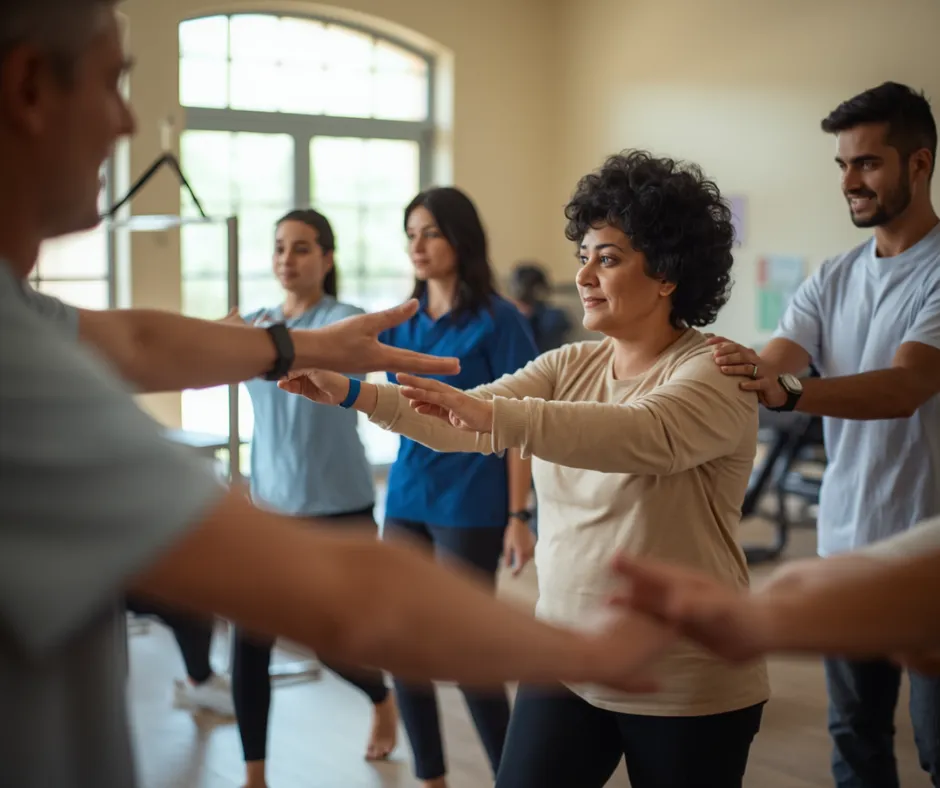
Gaby uses mindfulness, breath work, and guided movement to help patients learn to listen to their bodies without panicking. Even a few focused breaths, she explains, can begin to shift the nervous system out of fight-or-flight. "Breath is the easiest way to change how we feel in the moment. Even a few breaths can create a reset."
If you'd like to understand how this approach is used in structured pain recovery programs, this article on mindfulness in SIMP rehabilitation goes into detail.
Sleep: Your Brain's Most Powerful Recovery Tool
Sleep disruption is one of the most underappreciated complications of a work injury, and one of the most important to address directly.
The brain's sleep systems love predictability. When injury removes the schedule that used to govern your day, the alarm, the commute, the structure of a workday, your brain loses its anchor. Combined with pain and psychological stress, this creates a feedback loop that can take weeks to break without intentional effort.
A few strategies that help:
Keep a consistent sleep and wake time. Even without work obligations, going to bed and waking at the same time anchors the brain's circadian rhythm. Your brain responds to regularity even when your life feels unpredictable.
Protect the 30 minutes before bed. Turn off screens, phone, tablet, TV. The blue light signals to your brain that it's still daytime, delaying the release of melatonin and reducing sleep quality.
Don't only treat the pain, address the worry. Sleep is often more disrupted by rumination about the future, finances, and the claim process than by physical pain alone. This is one reason that behavioral health support is an important part of a complete recovery plan, not a last resort.
When a Head Injury Is Part of the Picture
For workers who sustained a concussion or traumatic brain injury (TBI) at work, the emotional and cognitive picture becomes significantly more complex.
Microscopic changes in brain cells following a head injury can directly affect mood regulation, emotional processing, and impulse control, often before the worker or their care team recognizes these symptoms as brain-related. Headaches, sensitivity to light or sound, a persistent "foggy" feeling, difficulty concentrating, fatigue, irritability, and emotional volatility are all potential signs of a mild TBI that can easily be mistaken for purely psychological symptoms.
This matters because the right diagnosis leads to the right treatment. If you experienced a head impact at work, even one that seemed minor at the time, it's worth discussing lingering cognitive or emotional symptoms with your provider. A neuropsychological evaluation can clarify what's happening and inform a treatment plan tailored to brain recovery, not just mental health management.
Mental Health Screening Shouldn't Stop at Week One
One insight Anne Hardy shared that often surprises people: emotional needs don't show up on a fixed schedule.
"I screen patients for depression and anxiety throughout care," she explained, "because mental health needs do not always appear during the first appointment."
The stress of week one looks different from the stress of month four, when a worker is still off work, their claim remains unresolved, and they're beginning to question whether they'll ever get back to normal. What feels manageable at the start can become much heavier over time.
This is one reason Convivio Health takes an integrated approach to care, not simply treating the physical injury, but actively monitoring emotional well-being across the full arc of recovery. For a deeper look at the resources available, our article on mental health support for injured workers in Washington State covers what to expect and what's covered under workers' comp.
You're Not Failing. You're Adjusting.
There's a persistent myth that injured workers who struggle emotionally are somehow milking the situation. The clinicians we work with, physicians, nurse practitioners, neuropsychologists, and occupational therapists, hear this and push back clearly.
The vast majority of injured workers want to return to the work and life they had before their injury. The emotional difficulty they experience is not evidence of fraud or exaggeration. It's evidence that recovery is hard, and that it involves more than healing tissue.
When providers treat injured workers as whole people, when they take time to understand the identity disruption, the financial stress, and the nervous system's alarm state, outcomes improve. Patients engage more fully in treatment. Recovery moves faster. Workers return to their jobs with confidence rather than fear.
For a patient perspective on how a nurse practitioner approaches this work, Anne Hardy's recent interview is worth reading.
You Don't Have to Navigate This Alone
If a work injury has left you feeling physically stuck, emotionally overwhelmed, or uncertain about what comes next, you're not alone, and there is support designed specifically for what you're going through.
At Convivio Health, our interdisciplinary team is built for exactly this. Physical therapists, occupational therapists, neuropsychologists, behavioral health providers, and occupational medicine physicians work together under one roof so your emotional and physical recovery is addressed together, not separately.
Whether you're dealing with sleep disruption, fear of movement, low mood, the cognitive effects of a head injury, or simply the weight of an uncertain recovery process, our team is here to help you find a path forward.
Contact Convivio Health today to learn more about our programs, or speak with your claims coordinator about a referral.