BIRP Frequently Asked Questions
A brain injury from a work accident raises a lot of questions, for patients, families, and the providers guiding recovery. This page answers the ones we hear most often. Whether you are preparing to start the program, supporting a loved one, or considering a referral, we hope this helps.
01- What standard treatment addresses
For Patients and Families
What is the BIRP program?
When a brain injury doesn't improve with standard care, recovery can feel stuck. The Brain Injury Rehabilitation Program, BIRP is designed for exactly that moment. It brings together a full team of specialists working on your recovery at the same time: physical, cognitive, emotional, and vocational. Instead of seeing one provider at a time, you get coordinated care where everyone is working toward the same goals together.
How is BIRP different from regular physical therapy?
Physical therapy focuses on movement and strength. That is valuable, but for many brain injury patients, the challenges go further than that. Memory, concentration, balance, fatigue, and emotional wellbeing all affect recovery, and they affect each other. BIRP addresses all of these at once through a team that communicates daily. The difference is coordination. Your providers are not working in sequence, they are working together.
How do I know if I am a good fit for BIRP?
BIRP is a good fit when standard care has run its course and you are still not where you need to be. Common signs include: memory or concentration problems that haven't improved, ongoing dizziness or balance issues, fatigue that limits more than just physical activity, low confidence about returning to work, and feeling like progress has stalled. Your doctor can request an evaluation, and the team at Convivio Health will take it from there.
What will my days look like in BIRP?
The program runs Monday through Friday, 9:00 AM to 4:00 PM. Each day includes a mix of physical rehabilitation, cognitive exercises, group sessions, psychological support, and vocational training. Your schedule is built around your goals and adjusted as you progress. It is structured, but the structure is there to support you, not overwhelm you.
How long is the program?
The active phase is 8 weeks. After that, some patients move into a follow-up phase based on clinical need. The team decides together what follow-up looks like for each person, there is no one-size-fits-all answer.
What happens when the program ends?
Before you finish, the team builds a discharge plan with you. This covers what progress you made, what you can do independently, and what the recommended next steps are, whether that is a graduated return to work, modified duty, or ongoing community support. You leave with a clear picture, not just a completion date.
Do I need a doctor's referral?
Yes. Your attending physician sends the referral to Convivio Health. If your injury is covered by Washington State L&I, the referral goes through your claim. Once we receive it, we coordinate directly with your provider and case manager to get you scheduled.
Does L&I cover BIRP?
Yes. Convivio Health is an L&I-approved BIRP provider in Washington State. If your injury is a covered L&I claim and your doctor has referred you, L&I can authorize the program. Your case manager can confirm the details for your specific claim.
What if I live far from Lynnwood?
Distance should not be a barrier to care. Convivio Health has a Travel for Treatment program, and depending on your claim, L&I may authorize travel and lodging support. Contact us or ask your case manager what options are available for your situation.
What should I do to prepare?
Before you start, Convivio Health will collect your medical records and coordinate with your referring provider. On your first day, wear comfortable clothing you can move in. The team will walk you through the schedule and answer any questions before you begin. You do not need to prepare anything special, just show up ready to participate.
02- Clinical indicators
For Referring Providers
These are the clinical indicators that a work-related brain injury has moved beyond standard treatment's capacity:
Which patients are appropriate for BIRP?
BIRP is designed for work-related brain injury patients who have plateaued in standard care and continue to have functional deficits across two or more domains, cognitive, physical, emotional, vestibular, or vocational. The clearest indicators are: persistent cognitive difficulties after 6–8 weeks of appropriate care, psychological overlay developing alongside physical recovery, fatigue that limits function across multiple areas, and failure to progress toward return-to-work function.
When is the right time to refer?
Earlier is better. The most common referral mistake is waiting for maximum medical improvement under standard care. By that point, the patient has often been at a plateau for months, secondary complications have developed, and the claim has grown more complex. A BIRP referral is appropriate when return-to-work function is the remaining gap, not acute symptom management. Patients should be medically stable enough to tolerate a structured daily program, but that threshold is typically reached well before MMI.
How does the referral process work?
Fax a referral to (425) 775-9634 with the patient's diagnosis, functional status, prior treatment history, and any relevant records. We review the referral and reach out to you and the patient to coordinate next steps. If L&I authorization is needed, we handle that process in coordination with the case manager.
Does L&I cover BIRP, and how does authorization work?
Convivio Health is an L&I-approved BIRP provider. Once we receive a referral, we initiate the authorization process, preparing the treatment plan documentation and coordinating with L&I and the case manager. You do not need to manage authorization on your end beyond the initial referral. We keep you updated on status.
How do you communicate with me during treatment?
We provide regular progress updates throughout the program. At the end of the active phase, you receive a comprehensive discharge summary covering functional outcomes across all domains, recommendations for next steps, and return-to-work status. Our team is available by phone or fax if you have questions about a patient's progress at any point during the program.
What outcomes should I expect?
By the end of the active phase, the goal is measurable improvement in cognitive function, physical tolerance, emotional regulation, and work readiness. We track outcomes across all domains throughout the program and report against the goals established at the start of care. Not every patient returns to full duty immediately, but every patient leaves with a clear functional picture and a documented plan.
How do I reach Convivio Health to discuss a case before referring?
Call (425) 774-9564 or fax (425) 775-9634. You can also submit a referral online at cvohealth.com/client-referrals. We are happy to discuss a case before a formal referral is submitted.
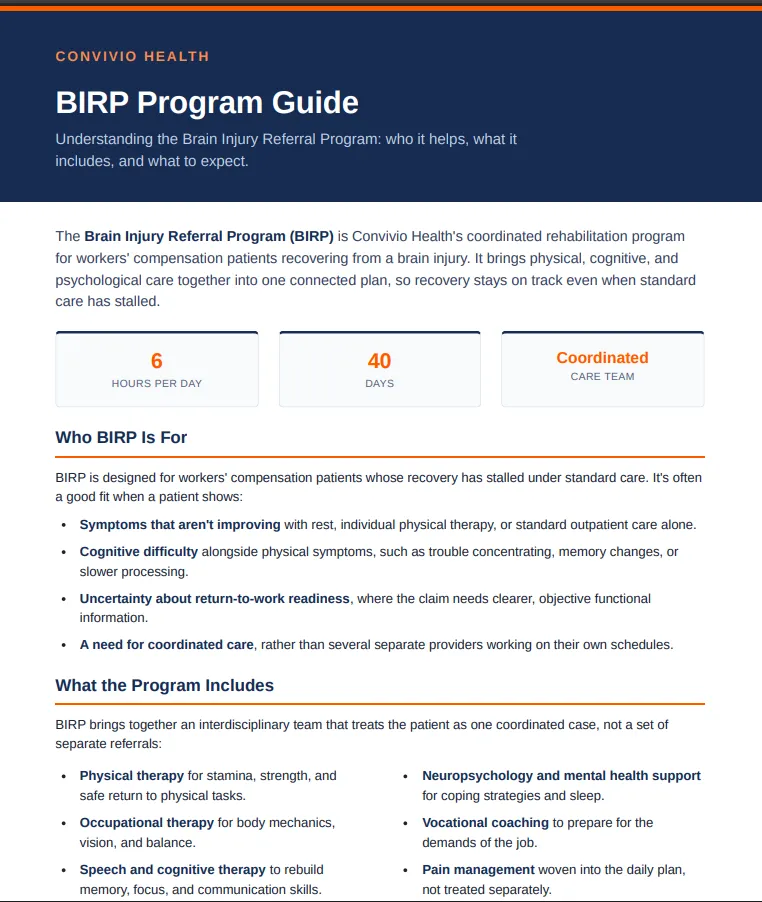
BIRP Program Guide
Understanding the Brain Injury Referral Program: who it helps, what it includes, and what to expect.
Still Have Questions?
We are here to help. Contact our team directly or submit a referral and we will be in touch.

FOLLOW US


COMPANY
Support/Legal


Convivio Health | 16201 25th Ave W Lynnwood, Washington 98087 | Email: [email protected] | Phone: 425.774.9564 | Fax: 425.775.9634
Convivio Health | 16201 25th Ave W Lynnwood, Washington 98087 | Email: [email protected] | Phone: 425.774.9564 | Fax: 425.775.9634
Copyright 2026. Convivio Health. All Rights Reserved.